CrashDefNet
CrashDefNet (Crash Deformation Network) is a research tool that learns from crash simulations how a structure deforms. A graph neural network is trained on the finite element mesh of simulated runs and then predicts new runs step by step, each step starting from its own previous prediction. CrashDefNet covers the whole way from the raw simulation data to the evaluation and makes it quick to add and compare new network architectures.
What CrashDefNet is for and what it offers: purpose and highlights.
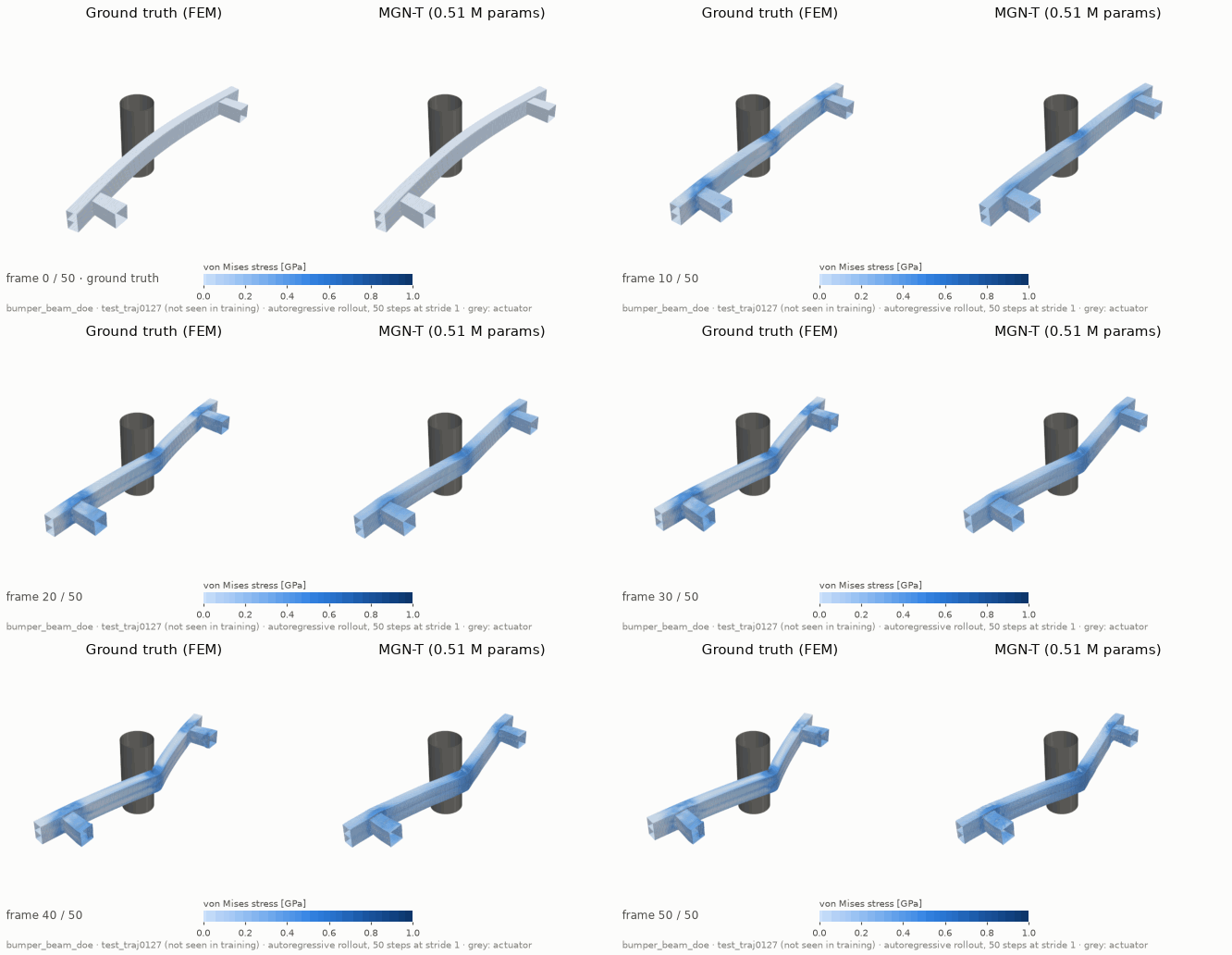
Autoregressive rollout of a bumper beam against a pole, 50 steps from the undeformed state to 100 ms, for a test run whose combination of geometry, impact velocity, shell thickness and pole position was not part of training. Left: OpenRadioss simulation from OpenRadioss-BumperBeam-DoE135 (CC BY-NC 4.0); right: MGN-T (results). Colour: von Mises stress.
-
Getting started
Run the whole workflow in minutes, install CrashDefNet and follow the tutorials.
-
Guides
Use the app, export and explore datasets, read OpenRadioss runs, train, roll out, evaluate, add an architecture.
The app · Export · Explore data · OpenRadioss runs · Train · Roll out · Evaluate · Add an architecture
-
Concepts
How the graphs, models, training and metrics work, and how the data scale.
-
Reference
Every command line option, config key and file format.
The CrashDefNet app
A graphical interface: one command opens a page in your browser, on your own machine, that leads through a first run in minutes without typing commands (the app).
python utils/app.py
Needs the installation. Without installation, the quick start runs on Google Colab (quick start).
Results
MGN-T on a real crash example, OpenRadioss runs of a bumper beam against a pole. On a design of experiments of 135 runs, with geometry, velocity, thickness and pole position varied, from the undeformed state on 14 unseen runs, next to the results of Akhare et al.: bumper beam DoE. Over the whole impact on 7 unseen runs with varied beam thickness and pole position: bumper beam.
MGN-T and MeshGraphNets under the same protocol on 20 unseen test geometries of DeepMind's original splits, made with an earlier version of CrashDefNet: deforming plate results. The numbers are preliminary and not a reproduction of the papers.